Posts

Dinosaurs

Image
 I've been having a break from Tirenia, but I had a strange thought and wanted to get it down. What are dinosaurs? Dinosaurs were created in the War of the Host as living weapons. They were meant as living weapons. Eventually, they led to the creation of dragons, when some bright spark demon had the idea of putting a soul inside one and giving it wings and innate magic. (This also means that in Tirenia, birds did not evolve from dinosaurs, and might in fact pre-date them! What a strange thought...)Who are these angels and demons who enjoy flesh-shaping so much? What happened to the dinosaurs since then? Doubtlessly there are still some hidden away in the remote places of the world in the remote places. Perhaps some fairy or demon will bring them forth again as part of the Tirenian Wars! The Primitive World . Adolphe Pannemaker, 1857.
The Story So Far (Updated)

Image
 Dragon Princes now has quite a complicated storyline! With every game influenced by those that came before it, and influencing those that are yet to come, there's a lot going on. You don't need to know the story across the multiple games to appreciate what's going on in your game, but if you're interested, this is a quick summary of the entire thing so far. As more games get played, I'll update this post! 1015, Summer The mercenaries of the Company of the Wolf stop the bronze dragon Generale Corragio from conquering the Salassi Valley in north-western Tirenia.  (The Company of the Wolf) 1015, Autumn The Company of the Wolf discover the ancient system of monoliths designed by the last gold dragon emperor to channel magic and destroy it before it could fall into the hands of the red dragon Rubina. Rubina and the company are killed in the explosion. The fall of the monolith network sends a surge of magic throughout Tirenia.  (The Company of the Wolf) Rubina's skul...

The Giant's Tomb

Image
  Recently, I had to run a very session of D&D over Zoom for patrons of the library. It would have been easy to do something generic; instead, I decided to do something a bit more complex. I present: The Giant's Tomb. In the winter of 1017, Cercius the Sibilant, a snake-head priestess, was disturbed by bad dreams. She realised that the dreams were prophetic: that Ahiman the Giant-King was stirring from his slumbers. Long ago, a group of humans had studied the meta-physics of the world, and figured out the secrets of draconic power - how to reincarnate sequentially in their own body, and thus grow in power and stature as dragons do. Ahiman was the philosopher who made this discovery, and shared it with his race. They used it to establish mighty powers, to create life, and to enslave the world around them. Only a coalition of heroes and dragons of the ancient times, and the rebellion of their created servants, was able to bring an end to their power. Seeing his end coming, Ahiman...

The Ruins of Auromia, Sessions 11-13 and Retrospective

Image
After two years and two months, we finally finished The Ruins of Auromia ! I notice that I've been lax I writing up session reports, so this will be a general overview of what happened, where the characters wound up, and how the world has changed going forward as a result. In Session Eleven, the dead characters went through Purgatory. They confronted their past lives and managed to process some of it. They also met some of the Fairies living in Purgatory. In Session Twelve, the dead characters returned to life with new fairy powers and united with their allies in Baraccoppoli and amongst the free fairies. They attacked the ghost armies of Bellona and found the gold dragon vault where the last artifacts were hidden. They also were warned about their former employer, Aurelian the undead gold dragon. In Session Thirteen, the players fought the servants of Bellona and rescued Tellaia from captivity. They convinced her to help them destroy the fairy relics at the Temple of Morta. Bellon...

A Pause

Image
 Hi everyone - I'm putting this blog on hiatus while we're in lockdown. I've got an idea for a new RPG article series, which will start when lockdown levels drop and stress levels drop!  Stay safe everyone! Image: 'Doctor Beak.' Paul Furst, c. 1650.

Player Agency in Tirenia

Image
Giving players control over the story has always been a great interest of mine. Like many of us, I was raised on games like D&D which have a strict division of authority: one player creates the world, while the other players interact with it. However, over time I got to try different, more indie systems which distribute narrative control more widely. I played games like Doctor Who, which uses story points to give players limited control over what happens, and gives weaker characters far greater narrative agency than powerful ones for the sake of game play. There are games like Fiasco, which dispense of the narrator rule entirely, making all players equally responsible for what happens in the game. I decided that I wanted to try some of that in Tirenia. In the first Tirenian campaign, The Company of the Wolf,  I tried taking a page from Doctor Who. The players were part of an elite mercenary company who were routinely hired to do the impossible. I let them use Inspiration, gaine...

What's a Renaissance? A historical digression

Image
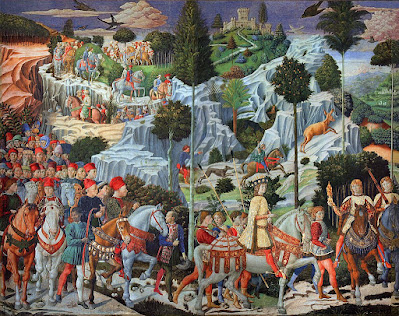
It's an odd thing to admit, when you're making a game about the Renaissance... that there's really no such thing. The popular conception of the Renaissance is that in the 15th Century, starting in Florence and then spreading across Europe, there was a time of great art and culture, as people looked back to Roman times to begin developing again after the squalor of the Middle Ages. Everyone can name some of the great artists, if only because they're named after Ninja Turtles: Leonardo da Vinci, Donato di Niccolo di Betto Bardi, Raffaelo Sanzio da Urbino, and Michelangelo di Lodovico Buonarroti Simoni.  The problem is that none of this is really true. Well, it is true that there were some great artists named after Ninja Turtles, and that they have really amazing art. But the Renaissance stretches over a truly immense time period: some people include Dante Alighieri in the early 1300s, to William Shakespeare in the early 1600s. It presupposes that there was no art or cultu...